People Are Inconsistent
Standard economic theory assumes people make consistent choices over time. The Exponential Discounting Model predicts that the utility of future consumption falls at a constant rate. In other words, for each incremental increase in delay, utility should decline by a fixed proportion.
Of course, data show otherwise. We asked participants how much they would need to be paid to make waiting for 3 months, 1 year, and 3 years as attractive as immediate payment of different prize or fine amounts. Median responses, as well as continuously compounded discount rates (in brackets) are shown in the tables below.
Choosing Between Now and Later
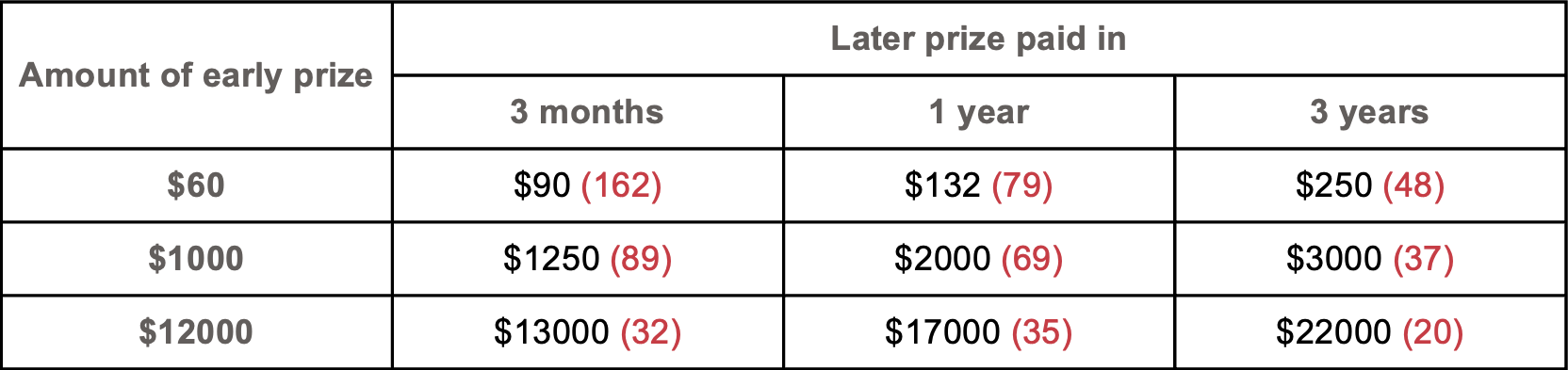
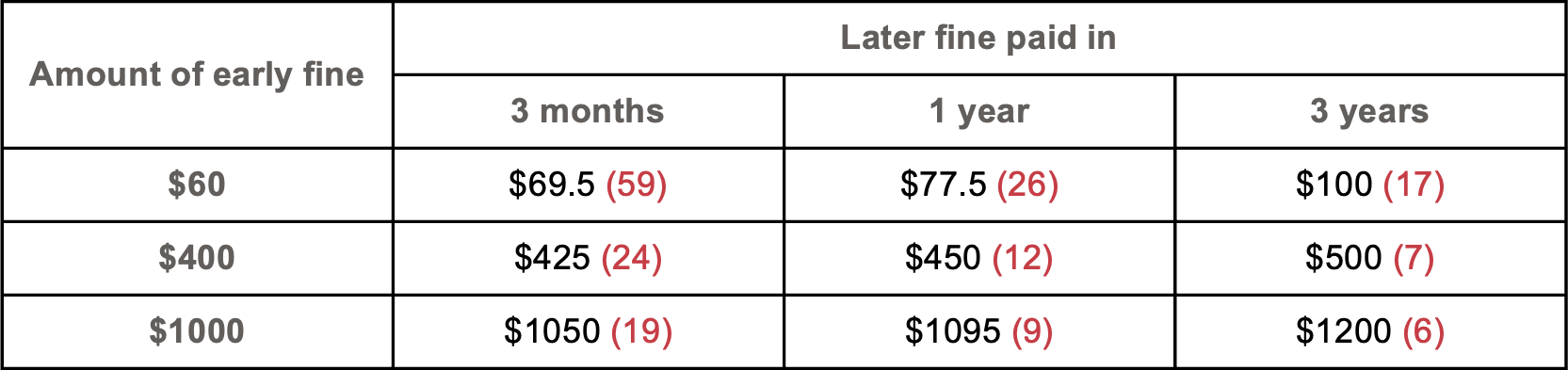
Apart from inconsistent discount rates, several patterns emerge:
Discount rates fell drastically as the waiting period increased.
Discount rates fell as reward amounts increased.
Discount rates for gains were much higher than for losses (i.e., subjects unwilling to pay much to delay paying the fine).